

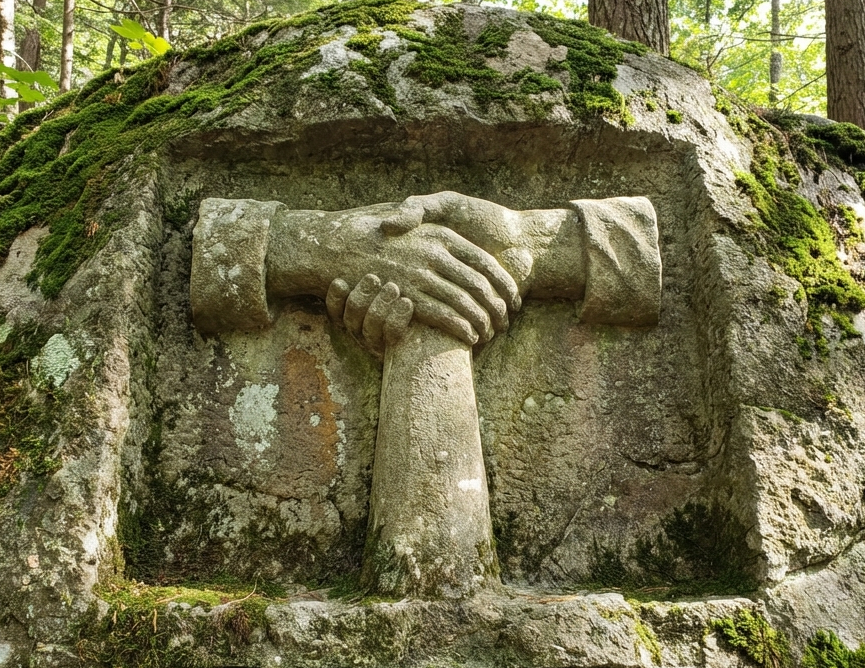
Content without Meaning
It did not arrive as a revolution.
There were no alarms, no ceremonies, no sense that some threshold had been crossed. Creation simply became easier, then effortless, then automatic. Words assembled themselves. Images appeared on demand. Thought seemed to flow without resistance, as if the friction of expression had finally been engineered away.
This was celebrated as liberation.
And in a narrow sense, it was.
But something subtle became missing in the process. Not intelligence, not even accuracy, something quieter. The pause before expression. The reflection. The struggle that forces clarity. The internal negotiation where half-formed ideas are either strengthened or abandoned.
Most people who began “creating” in this new way were not dishonest. They were not trying to deceive. They were simply overwhelmed. They mistook access for understanding, fluency for insight, output for authorship.
They spoke to machines without realising that machines reflect more than they originate.
The results were coherent, confident, but largely hollow. Language without experience. Explanations detached from the cost of learning. Knowledge assembled like furniture from flat-pack instructions, structurally sound, but lacking that craftsmanship and genuine material.
The most curious consequence was this: the creators themselves often believed they had learned something.
Sadly, they had not.
They had produced.
And in a world increasingly optimised for production, that distinction quietly stopped mattering.
Saturation Slop
The accumulation did not overwhelm at first. It arrived as abundance, then convenience, then eventually became a background noise.
Content multiplied faster than attention could track. Articles echoed articles. Videos restated summaries of summaries. Every idea appeared endlessly explained, yet strangely unexplored.
People did not turn away because the content was offensive or wrong. They turned away because discernment became impossible.
So a second adaptation emerged.
If one could not (or did not need to) read everything, one could at least compress it.
Machines were asked to summarise what machines had helped create. To extract meaning from material no one in the chain had necessarily understood. To tell the overwhelmed humans what mattered, when no shared agreement existed on what “mattering” even meant.
This is where the loop closed.
Incompetent creation fed automated ingestion, which fed belief.
Meaning thinned with each pass, like a photocopy degraded through too many copies. What survived was not falsehood, but confidence without grounding. Conclusions without lineage. Opinions no one had personally expressed nor earned.
Reality did not collapse. It continued, operationally intact.
But something essential fractured: the relationship between knowing and believing.
People began to hold views they could not defend, derived from summaries of texts they had not read, authored by voices no one could place.
This was not an information crisis.
It was an epistemic one.
Yet We Continue
The correction will not come as regulation. It will come as fatigue.
A quiet, spreading hesitation. A sense that too much was being said, and too little was being meant.
People stopped asking, “What does this say?” and began asking something more primitive:
Who is speaking, and why should I listen?
Attention narrowed. Consumption slowed. Trust became selective.
Not institutional trust. Not credential authority. Something older and more personal.
Continuity.
The visible shape of a mind over time. The willingness to show reasoning, not just results. The courage to mark the boundary between fact, inference, and speculation. The humility to say “I don’t know” without retreating into silence.
In this environment, imperfection became a signal. Uncertainty, a form of honesty.
AI did not disappear.
It was repositioned.
No longer an oracle. No longer a replacement for thought. But an instrument, used by trusted minds to audit, to challenge, to widen perspective without erasing responsibility.
This was not a return to a pre-AI world.
It was a co-evolution. Human intention and machine capability, aligned rather than entangled. Coascendence
Trust, the new currency
We are entering an age where creation is effortless.
Meaning is not.
In the end, trust becomes the only thing that cannot be mass-produced.
It cannot be scraped.
It cannot be summarised.
It cannot be generated on demand.
Trust requires time. Repetition. The willingness to be wrong in public and correct oneself without spectacle. It requires a visible relationship between thought and consequence.
In a world drowning in content, trust becomes the compression algorithm for reality.
And those who understand this do not shout.
They speak carefully.
They cite their doubts.
They treat AI not as a replacement for thinking, but as a mirror held up to it.
The future does not belong to the loudest, nor the fastest, nor the most prolific.
It belongs to those credible ones who can still be believed.




Leave a Reply