We humans are creatures of comfort. Genetically wired for stability from early days. Our ancestors thrived by building routines around fire, food, and familiar faces. Fast-forward to today, and we still seek stability and form habits. A new job? Anxiety spikes. Moving house? Cue the packing-induced panic attacks. However, it’s not the change itself that’s the biggest culprit, it is the ‘unknown’. That foggy “what if” that turns our brains into overclocked worry machines and sleepless nights.
Back in my college days, studying psychology, I stumbled upon the Holmes-Rahe Stress Scale. A nifty chart that scores life events like a grim video game. Divorce? 73 points. Getting fired? 47. Rack up over 300 in a year, and you’re statistically at risk of a health meltdown. The beauty (and terror) of it was its simplicity: it quantified the chaos, helping spot when stress was sneaking up on you. We all know a dash of stress can be rather beneficial, pushing us to adapt and grow, but chronic, long-term stress? That’s the silent killer, eroding our mental resilience even when we think we’re “handling it fine.”
And now we face the perfect storm. Enter AI…
Monitoring AI’s evolution over the past few years feels like trying to track a supersonic jet with a pair of binoculars. From early chatbots that made a mockery of the Turing test to current systems generating art, code, and even simulating “empathy” on demand, the progress is truly mind-blowing. The worst part however is that this isn’t a gradual progress we can ease into. It’s a complete rewrite of our processes, jobs, and societies, all happening at warp speed. We’re not just desperately trying to adapt to new tools; we’re grappling with “unknown unknowns,” those curveballs we didn’t even know to anticipate. And they’re coming at us fast!
We have not yet fully recovered from the last global disruption. Remember the pandemic? It almost seems like ‘round one’: a global health crisis that upended everything from work to weddings and left a huge aftermath of mental health issues. We barely caught our breath, and now here’s round two. Seems a bit unfair to compare AI to Covid, but with even less predictability and the rapid pace of change, we can’t even imagine what long term effects it will have on our mental wellbeing. We don’t have historical playbooks or time for thorough simulations. By the time we model a scenario, the tech has leaped ahead, revealing new risks and fears, like deepfakes eroding trust or algorithms amplifying biases on a massive scale.
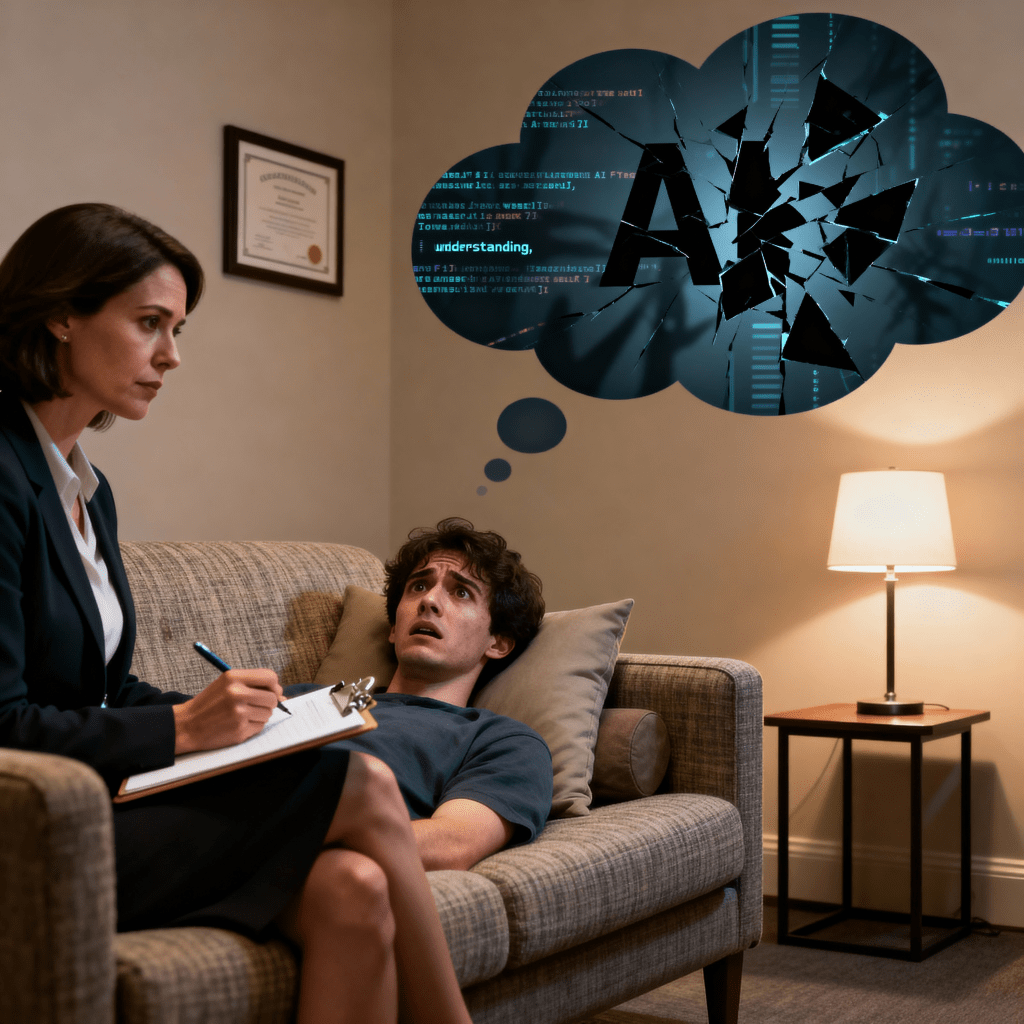
The result? Skyrocketing anxiety across the board. Jobs vanishing not to outsourcing, but to code. Social interactions mediated by AI “friends” that know us better than our actual pals. Even our sense of self: ‘am I creative, or is that just a prompt away?’ If we slapped this on the Holmes-Rahe scale, “Navigating AI-driven societal upheaval” I could easily imagine it clocking in at a whopping 150-200 points. Add to that several more ‘traditional’ daily struggles and large percentage of the ‘first world’ would easily exceed the threshold. Multiply that by billions of people, and we could be facing a ticking timebomb.
Here’s where it gets really serious: we’re not equipped for this. Our brains evolved for a more gentle pace of technology adoption. Prolonged exposure to this pace, together with the uncertainty of the path, could lead to widespread burnout, depression, or worse; a societal numbness where we stop questioning the changes altogether. Imagine a world where “adapt or die” becomes the mantra, but at what cost to our humanity?
Humans are also pre-wired for hope and we do rise to most challenges. History tells us so time and time again. Awareness is step one. Tools like that old stress scale remind us to check in with ourselves, track those anxiety spikes, seek support, and maybe even unplug from the tech and AI echo chamber now and then. Policymakers could step up with ethical guidelines, slowing the roll-out to give us breathing room. And us individuals? We can embrace the beneficial stress, learning AI skills not out of fear, but curiosity.
In the end, technology and AI isn’t the enemy; it’s the accelerator. The real question is, can we grab the wheel and steer without crashing? Or will the ‘unknown unknowns’ claim our sanity first? I’d love to hear your thoughts in the comments. Have you felt the AI anxiety creep in? Share your stories, and let’s ponder this together before the next upgrade hits.






 Coascendence
Leave a reply to D8MSK1 Cancel reply