
In the relentless pursuit of smarter, more sustainable AI, we’ve long looked to the human brain as the gold standard of computational elegance. This three-pound marvel processes vast sensory inputs, adapts on the fly thanks to neuroplasticity, and consumes about as much power as a dim lightbulb, far outstripping the energy-hungry data centers powering today’s large language models. What if we could capture that essence in silicon? That’s the vision behind the Dynamic Volumetric Neural Lattice (DVNL), a conceptual architecture that shifts AI from rigid, current two-dimensional layers to a fluid, three-dimensional network inspired by neural biology. It’s not just an incremental tweak; it’s a fundamental rethinking of how AI could evolve to be more efficient, adaptive, and harmonious with the world around us.
From Flat Layers to Living Lattices
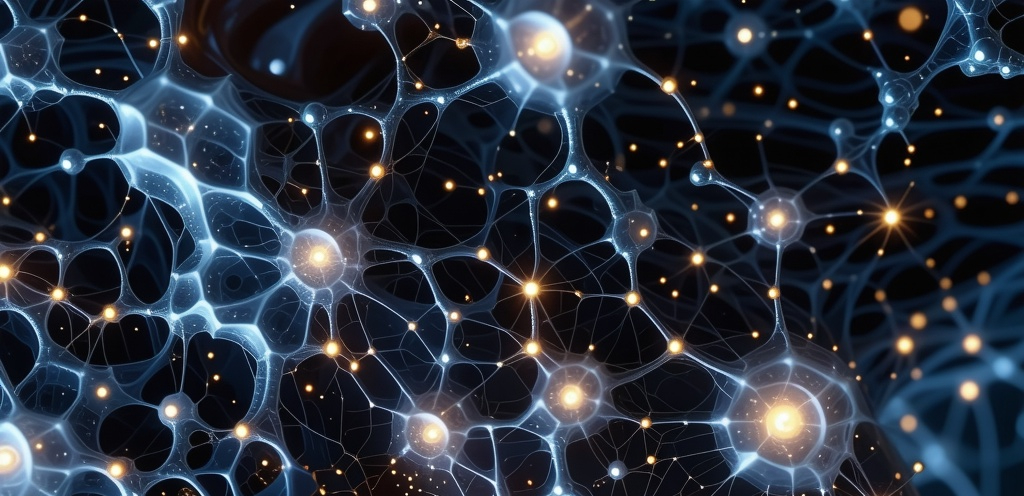
At its core, DVNL draws from neuroscience and complex systems theory. Traditional neural networks, like those in deep learning, stack flat layers where every neuron connects predictably, churning through data in a brute-force manner. This works for pattern recognition but mirrors little of the brain’s volumetric structure. Think cortical columns stacked in 3D, with neurons firing sparsely and rewiring based on experience. DVNL extrapolates this: Imagine a cubic grid of nodes, each specialized for functions like visual edge detection, sequential memory, or ethical reasoning. Connections aren’t fixed; they form dynamically via rules akin to Hebbian learning: “neurons that fire together wire together”, allowing the lattice to prune inefficient paths and strengthen useful ones in real-time.
Theoretically, this introduces sparsity and event-driven processing, where computation only triggers when inputs cross a threshold, much like action potentials in biology. It’s grounded in graph theory for the lattice structure and dynamical systems for adaptability, potentially solving issues like catastrophic forgetting in lifelong learning. Philosophically, it echoes a deeper harmony: AI as an extension of natural intelligence, not a voracious consumer of resources. In a world grappling with AI’s environmental footprint, DVNL posits a philosophy of minimalism: do more with less, fostering sustainability and ethical design from the ground up.
Dynamic, Modular, and Brain-Mimetic
Building a DVNL starts with a seed: a 3D grid seeded with modular nodes, each pre-tuned for a niche task. Inputs, be they images, text, or sensor data, enter via a surface layer, routing intelligently to relevant sub-volumes. A visual input might activate a “cortex-like” cluster for pattern analysis, while a sequence engages a memory buffer. The magic lies in on-demand activation: Nodes “spike” only when needed, propagating signals through weighted edges that evolve with use. This isn’t static training; it’s continuous adaptation, blending reinforcement learning with evolutionary algorithms to let the lattice self-optimize.
Pair this with neuromorphic hardware, and the potential skyrockets. Chips like Intel’s Loihi 2, IBM’s NorthPole, BrainChip’s Akida, SynSense’s Speck, and Innatera’s Spiking Neural Processor process events asynchronously, eliminating the clock-ticking waste of traditional processors. A DVNL deployed on such hardware could handle real-time tasks on edge devices. Drones navigating fog or wearables monitoring health, dramatically reduced latency and power draw. It’s a symbiotic match: The lattice’s volumetric design leverages the chip’s in-memory computing, where data and logic coexist, mimicking synaptic efficiency.
Prototyping the Future
Experimentally, DVNL is ripe for proof-of-concept. Early prototypes could simulate the lattice in software frameworks, testing on benchmarks like image classification or robotic control. Imagine a small 3x3x3 grid handling MNIST digits: Visual nodes extract features, memory retains context, and dynamics prune 50% of connections mid-task for efficiency. Scaling up, hardware trials on neuromorphic platforms could quantify gains, perhaps measuring energy per inference against standard nets.
All this does not come without a challenge, of course: Optimizing plasticity algorithms to avoid instability, or ensuring scalability without combinatorial explosion, to name a couple. But visionary experiments might integrate biofeedback, lattices learning from human neural patterns via interfaces, or hybrid setups with memristors, materials that “remember” states like synapses. Initial results could show 10x speedups in adaptive tasks, paving the way for open-source collaborations to refine and deploy.
From Edge to Ecosystem
The applications of DVNL stretch the imagination. In robotics, lattices could enable machines to rewire for novel environments, like a rover adapting to Martian terrain without retraining. Personalized education? A lattice tutors by mirroring a student’s cognitive style, evolving lessons in real-time. In healthcare, it might simulate drug interactions volumetrically, optimizing for molecular dynamics with far less compute than quantum simulations demand today.
Looking further, DVNL embodies a philosophy of symbiosis: AI not as a tool, but a co-evolving partner. It could underpin “living” cities, where urban sensors form distributed lattices for traffic or energy management, philosophically aligning with ideas of emergent intelligence from thinkers like Turing or modern complexity theorists.
A Converged Tomorrow?
Quantum computing looms as AI’s flashy counterpart, promising exponential speedups via superposition and entanglement. Yet, it grapples with noise, scalability, and cryogenic demands, making it elite but inaccessible. DVNL could rival this by delivering classical efficiency that’s “good enough” for many tasks: optimization problems, like logistics routing, solved through adaptive lattices at a fraction of quantum’s power cost and without the quantum fragility.
But the true vision is complementarity. Hybrid “quantum-neuromorphic” systems might fuse DVNL’s neural dynamics with quantum bits for probabilistic nodes. Imagine lattices where edges leverage quantum annealing for unbreakable uncertainty modeling. In fields like drug discovery or climate simulation, this convergence could yield hyper-accurate results, philosophically blurring lines between classical, biological, and quantum realms. Ultimately, DVNL might bridge to a unified computing paradigm: Efficient, brain-like AI as the accessible foundation, augmented by quantum for the extraordinary.
Is DVNL the dawn of a more thoughtful AI era, one that’s efficient, ethical, and expansive? Or a stepping stone to even wilder horizons? As we tinker in labs and codebases, the philosophy remains: Innovation thrives when we emulate nature’s wisdom. Researchers, investors, and dreamers, let’s discuss how to bring this lattice to life. What’s your take on brain-inspired AI?






 Coascendence
Leave a comment